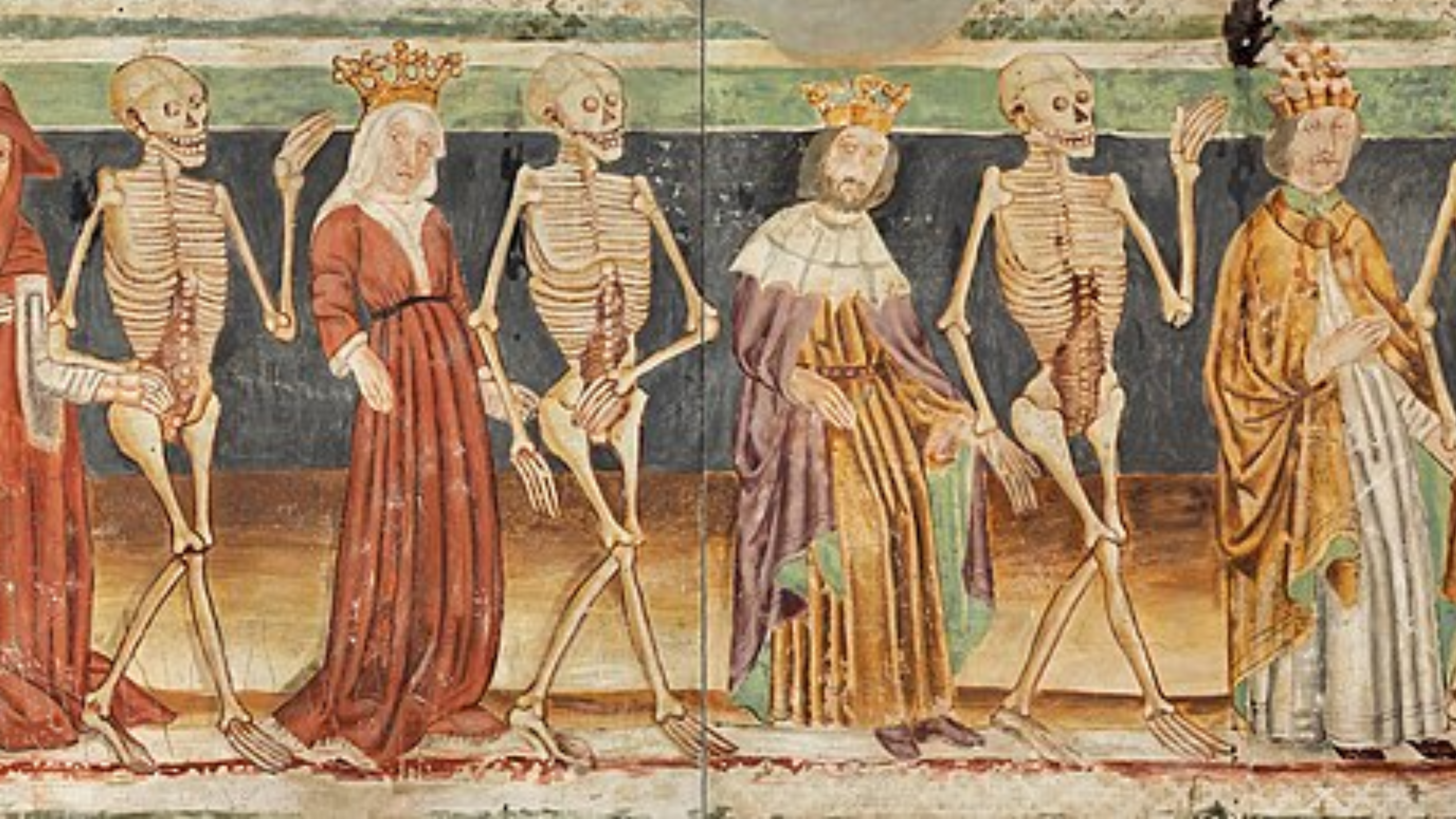
On plague, wages, and the difference between prosperity and its appearance.
In October 1347 a fleet of galleys put in at Messina carrying crews that were already dying, and within four years plague had moved through nearly the whole of Europe. Estimates of mortality vary by region and by method, but the range most economic historians work with runs from a third to something closer to half of the population, with some localities losing considerably more. It was the largest demographic contraction in recorded European history, and it arrived in a society that had spent centuries encoding social rank into cloth.
The story usually told about what happened next is straightforward and largely wrong. In the popular version, the sudden shortage of labour drove wages sharply upward, ordinary people found themselves with disposable income for the first time, and the nobility responded to the sight of well-dressed peasants by writing new sumptuary laws. The chronology of that account does not survive contact with the wage data. What actually happened is more interesting, and it says something more precise about how status regulation works.
The Wardrobe as Legal Instrument
Dress in fourteenth-century Europe was regulated with a specificity that is difficult to appreciate now. Sumptuary legislation appeared across England, France and the Italian city states, and it addressed not only fabric but colour, fur, trim, ornament and, in some jurisdictions, the permitted length of a shoe's point. What a person was permitted to put on their body was a matter for parliament.
England had been legislating on cloth for well over a decade before the plague arrived, and its motives were commercial as much as hierarchical. The Cloth Act of 1337 obliged everyone in the king's dominions to wear English-made cloth and barred the import of foreign cloth entirely, while restricting furs to those with incomes above £100 a year. Both measures were protectionist in design, intended to shelter an emerging domestic cloth industry. They were also an instrument of foreign policy: wool was England's most valuable export, and Edward III used control of that supply to pressure the Flemish counts into alliance against France. The same statutes that sorted people by rank were simultaneously a tariff regime and a diplomatic lever.
The material hierarchy those laws described was nonetheless real. Coarse undyed wool sat at the bottom, linen served largely for undergarments, and silk, velvet and the better furs belonged legally and financially to the nobility. What the laws could not do was fix that hierarchy in place once the economics underneath it began to move.
What the Textbook Predicts
The standard model of what a demographic collapse does to an economy is Ricardian in structure. If population falls sharply while land and capital remain, the ratio of land to labour rises, the marginal productivity of labour rises with it, and wages should follow. It is a clean prediction, and English governments of the period clearly believed something like it. The Ordinance of Labourers in 1349, followed by the Statute of Labourers in 1351, attempted to fix wages at their pre-plague levels. Legislation of that kind is not passed by people who expect wages to stay flat on their own.
The wage series, however, do not cooperate. John Munro's work on English and Flemish prices and wages establishes that the fourteenth century was already deflationary before the plague arrived. Real wages for building craftsmen in southern England peaked in 1336 to 1340, then fell through the 1340s and continued falling after the plague, into the 1360s. The proximate cause was that England experienced roughly thirty years of high grain prices following the Black Death — so whatever gains appeared in money wages were absorbed by the cost of bread.
The prosperity did eventually arrive, and when it came it was substantial. Real wages rose more or less continuously through the fifteenth century and reached a peak in 1476 to 1480 that would not be surpassed for a very long time afterward. The point is the timing. The so-called golden age of the English labourer was real, and it was also substantially delayed — arriving a full century after the ship docked at Messina rather than a decade.
"Parliament was legislating against conspicuous overdressing by the lower orders at precisely the moment those orders could not afford to be conspicuous."
A Law Written Before the Money Arrived
This creates a genuine puzzle. England's most comprehensive sumptuary statute, the Statute Concerning Diet and Apparel, was passed in 1363 — during the period when real wages were still at or near their trough. Its preamble complains of the "Outragious and Excessive Apparel of divers People, against their Estate and Degree, to the great Destruction and Impoverishment of all the Land." Parliament was legislating against conspicuous overdressing by the lower orders at precisely the moment those orders were, in real terms, no better off than they had been before the plague.
Several things can be true at once here. The first concerns stock rather than flow. Wages are an income flow, and the wage evidence tracks that flow. Mortality on the scale of the 1348 and 1349 outbreak also redistributed a large existing stock of movable property — including cloth, garments, plate and household goods — into the hands of a much smaller number of surviving heirs. A labourer whose real wage had not improved might nonetheless have inherited three cloaks.
The second concerns visibility rather than aggregate improvement. Sumptuary regulation responds to what elites observe, and what elites observe is not the average. A relatively small number of conspicuously well-dressed servants at market is sufficient to generate a sense of disorder, regardless of what the wage series says about the population as a whole. A statute is a reasonable proxy for elite anxiety and a very poor proxy for median living standards.
The third concerns the labour legislation itself. The Statute of Labourers had been on the books for twelve years by 1363 and was enforced unevenly. Where employers competed for scarce workers, wages were paid above the statutory cap in cash or in kind, and clothing was a common component of remuneration. A dress code violation was, in that context, also visible evidence that the wage law was being broken. The two statutes were addressing the same underlying problem from opposite ends.
What the Statute Actually Said
The 1363 statute set tiered limits by rank and by wealth rather than by birth alone. Grooms and servants of lords were restricted to cloth valued at no more than two marks for a full piece, with silk, gold and silver prohibited outright. Yeomen and craftsmen faced a cap of forty shillings. Ploughmen and agricultural workers were confined to blanket and russet cloth priced under a shilling. The same statute went on to prescribe the daily diet of servants.
Three features stand out. The first is that the thresholds are monetary: the law specified a price per cloth, which is a tacit admission that the relevant barrier had become financial rather than customary, and that the customary barrier was no longer holding on its own. A society confident in its hierarchy does not need to put a shilling value on it.
The second is that the scheme is indexed to income at the upper end and to goods at the lower end — a wealth test wearing the costume of a rank test. The third is the diet provision, which is easy to skip past: regulating what servants ate alongside what they wore indicates that parliament understood both as the same category of problem — the visible consumption of people whose consumption was supposed to be legible at a glance.
It failed quickly. The statute was repealed by the following parliament in 1364, with members asking for free trade in cloth to be restored, and there appear to be no recorded prosecutions under it. A comprehensive attempt to legislate the visual order of English society lasted approximately one year.
"When a status signal becomes available to people it was not meant to include, those relying on it have two options: restrict by law, or move to a costlier signal."
Legislate or Escalate
When a status signal becomes available to people it was not meant to include, those relying on it have two options. They can attempt to restrict access by law, or they can move to a costlier signal. The two are not equally effective, and the fourteenth century tried both. The legislative route has an obvious appeal, since it is cheap for the people writing the law and expensive only for everyone else. Its weakness is enforcement. The repeated reissue of such laws across two centuries, and the near-total absence of prosecutions under the 1363 statute, suggest the route was largely unworkable.
Escalation worked better, because it required no enforcement at all. Velvet is the clearest instance. It was technically demanding to produce, slow, and expensive in ways that no statute needed to declare. Its adoption among the European upper classes in the decades after the plague achieved through the market what the law could not achieve through prohibition. When a marker of distinction becomes widely available, distinction relocates rather than disappears.
The Italian city states illustrate the middle ground. Merchants in Florence and Venice, wealthy enough to afford restricted fabrics but not entitled to them, commissioned garments in fine wools and silk blends that operated at the edges of what the statutes prohibited. That is not defiance so much as arbitrage — and it is an early instance of a pattern that recurs whenever a rule is written in terms of specific materials rather than general intent.
What Remained
The window did not stay open indefinitely. Landlords found other means of suppressing wages, the labour statutes were reissued, and sumptuary laws continued to appear on the books for another two centuries. What the episode demonstrates is narrower than the usual telling but more durable. Sumptuary law is not a description of how a society dresses. It is evidence of anxiety about how a society is dressing, written by the people with the most to lose from ambiguity, and it is generally passed at the moment when the mechanism it defends has already begun to fail.
The 1363 statute tells us almost nothing reliable about what English labourers actually wore and a great deal about what the English parliament was afraid they might. That distinction is worth keeping, because the same confusion recurs whenever a status marker becomes affordable and someone proposes a rule to stop it. The rule is rarely the thing that holds. What holds is the next marker, priced out of reach without needing a statute to say so.
The Economic Wardrobe is an independent publication examining the economic forces behind what people wear. This article is part of Volume I.
← Return Home