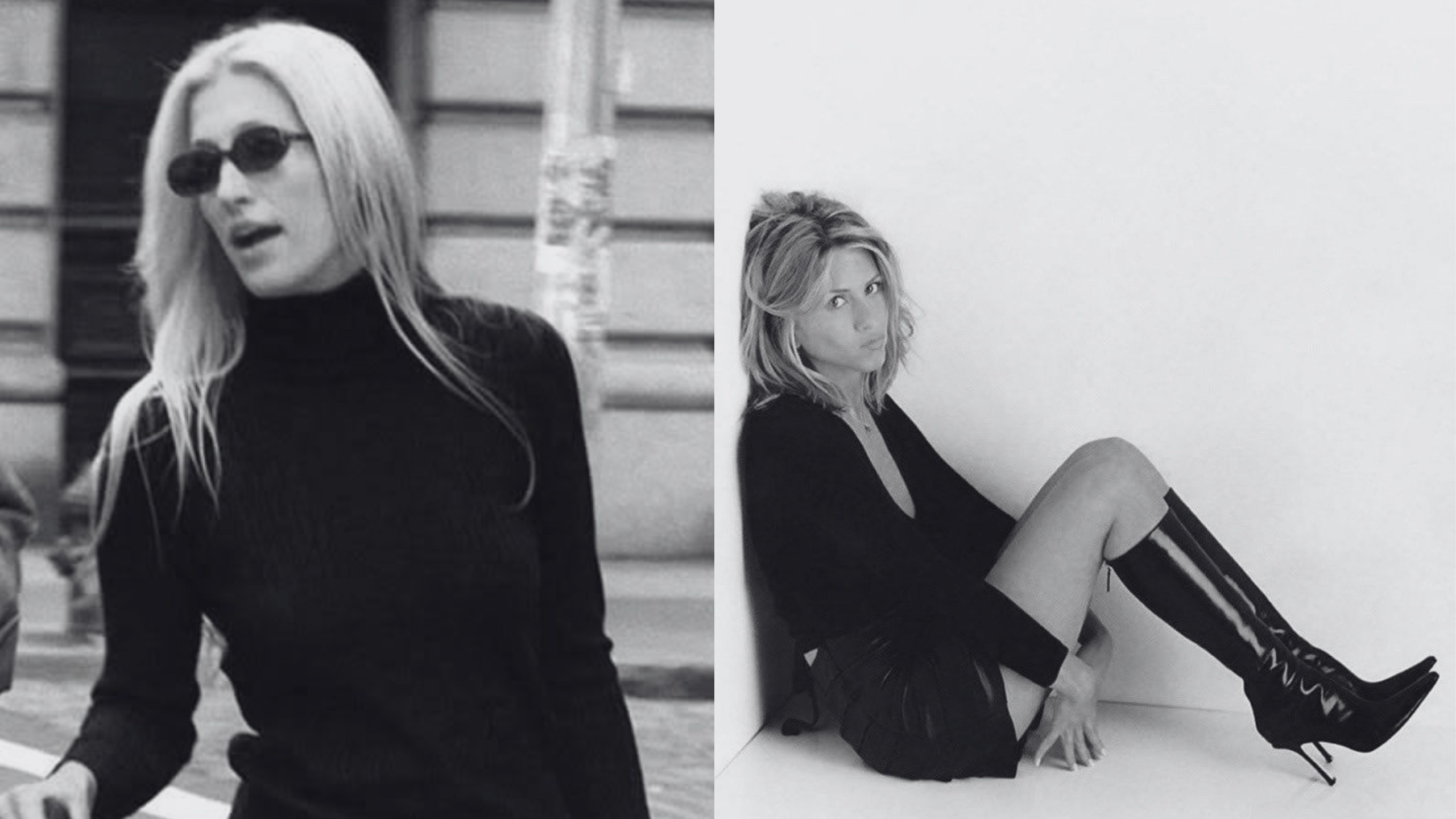
On recession, restraint, and the decade that learned to hide its money.
The 1990s did not invent minimalism. The vocabulary had been assembled over the preceding two decades by designers working in largely unrelated traditions: Halston, whose jersey and cashmere clothes made simplicity a distinctly American form of luxury through the 1970s; Giorgio Armani, who had been dismantling the structured shoulder since 1975; Jil Sander, who opened her first Paris showroom in 1979; and the Japanese designers who arrived in Paris in the early 1980s with an argument for the unadorned radical enough that the French press initially struggled to describe it. By the time the American recession arrived, the aesthetic language of restraint was fully formed and widely available to anyone who wanted it.
What changed at the turn of the decade, then, was not the vocabulary but its reception. An aesthetic that had circulated for twenty years as one option among many became, quite suddenly, the dominant register of American fashion, and the question worth asking is why a set of ideas available since 1975 found its audience in 1993.
Part of the answer lies in the labour market. In July 1990 the United States entered a recession that the National Bureau of Economic Research would eventually date at eight months, short by historical standards but unusually stubborn in its aftermath. Unemployment stood at 5.2 percent when the contraction began, and it did not peak until June 1992, at 7.8 percent, a full fifteen months after the recession had officially ended. It would not return to pre-recession levels until August 1996.
That lag is easy to overlook and hard to overstate. For a substantial share of American households, the recovery registered in the aggregate statistics several years before it registered in a paycheck. An aesthetic organised around the visible display of wealth sits awkwardly in a labour market where wealth cannot be assumed to persist, and it is in that gap — between a recovery on paper and a recovery in practice — that the decade's fashion economics become legible.
"An aesthetic that had circulated for twenty years as one option among many became, quite suddenly, the dominant register of American fashion."
What Broke the Eighties
The visual culture of the 1980s operated on a principle that Thorstein Veblen had named ninety years earlier in The Theory of the Leisure Class: conspicuous consumption, the practice of buying not for use but for the signal the purchase sends. A gold Versace medallion in 1985 was performing a very old function in a new idiom.
The system depended, however, on a stable expectation of future income, and that expectation was disrupted by a financial collapse which ran alongside the recession and outlasted it. The savings and loan crisis was the largest collapse of American financial institutions since the Great Depression. Between 1986 and 1995, 1,043 thrifts holding more than $500 billion in assets failed. New home construction fell from 1.8 million units a year in 1986 to 1 million by 1991, the lowest rate since the Second World War.
What it destroyed was regional property values, construction employment, and the broadly held assumption that asset prices move in one direction. It made wealth feel provisional — a different kind of injury from losing one's savings and, for the purposes of fashion, a more consequential one. Wearing a logo across the chest is, among other things, a wager that everyone watching believes the wearer will still be able to afford it next year. By 1991, across a good deal of the country, the bet had become considerably less safe.
Minimalism as Camouflage
Calvin Klein spent the middle of the decade building the visual language that most people now mean when they say "nineties": muted neutrals in cream, grey, black and beige; slip dresses; precisely cut coats; clothes that were expensive and declined to look it. The refusal to look expensive was not incidental to the product. It was, in a meaningful sense, the product itself.
There is an established name for what was happening. Economists and marketing researchers describe it as inconspicuous consumption: the signalling of status through markers that are deliberately illegible to outsiders while remaining instantly readable to insiders. Berger and Ward formalised the mechanism in 2010, showing that as luxury goods become more widely accessible, high-status consumers tend to shift systematically toward subtler signals — those requiring cultural knowledge to decode. Pierre Bourdieu had described the machinery underneath this three decades earlier in Distinction, arguing that taste is never neutral but functions as cultural capital, sorting people by class while appearing to do nothing of the kind.
Carolyn Bessette-Kennedy is the period's most cited demonstration of the principle. She worked in fashion publicity, latterly as a director of special projects at Calvin Klein, before marrying John F. Kennedy Jr. in 1996. The wardrobe she became known for was unremarkable in description: a white slip dress, a well-cut wool coat, little jewellery, no visible branding. Nothing in it announced wealth, and nearly everything in it implied wealth to a viewer equipped to notice. She remains a useful illustration of minimalism's central economic paradox: the most expensive item available was often the one engineered to look as though it had cost nothing at all.
"The most expensive thing you could wear was something that looked like it cost nothing."
The Khaki Conspiracy
The decade's most straightforwardly economic fashion story did not take place on a runway at all. By the early 1990s Levi Strauss faced a structural problem: jeans were weekend clothes, which meant that for five days a week the company was excluded from its customers' wardrobes by convention rather than by preference.
In 1992 the company produced an eight-page pamphlet titled A Guide to Casual Businesswear and mailed it to roughly 25,000 human resources managers across the United States. The document was not framed as advertising. It was written as a manual. Dockers khakis appeared throughout the illustrations, styled and unlabelled. The company followed the mailing with videos for corporate cafeterias, in-office fashion presentations, and a dedicated hotline that HR departments could call for guidance on drafting a policy.
By 1995, roughly 90 percent of surveyed US companies had adopted a full- or part-time casual dress code, up from around 66 percent in 1992, and Levi's posted record sales of $6.2 billion that year. A garment company identified a category it did not own, wrote the rules governing that category, distributed those rules to the people empowered to enforce them, and sold the resulting uniform — all on a timeline of roughly three years. The tailored suit never recovered its position as the default. Its decline is usually narrated as a cultural shift, and it was one. It was also, in part, a marketing campaign with a mailing list.
What Everyone Else Was Wearing
Grunge emerged from Seattle's working-class music scene, and its logic was material well before it became aesthetic. Flannel was chosen because it was inexpensive and warm; jeans were worn past the point of tearing because replacing them was a discretionary expense; thrift-store layering reflected the available price point in a region where wage growth had stalled. The look was not assembled to communicate anything in particular. It was, for the people who originated it, simply what was in the closet.
On 3 November 1992, Marc Jacobs presented his Spring/Summer 1993 collection for Perry Ellis: secondhand flannel translated into plaid-printed silk, lumberjack thermals reissued in cashmere, a version of Kurt Cobain's granny dress rendered in floating chiffon. Jacobs received the CFDA's Designer of the Year award in January 1993 and was dismissed by Perry Ellis shortly afterward. Luxury fashion borrows continually and comfortably from above. Jacobs borrowed from below and priced the result upward, which had the incidental effect of making the markup unusually easy to see.
Hip hop, meanwhile, was building a parallel fashion economy on entirely separate terms. The economic conditions were specific and severe: the crack epidemic, the collapse of manufacturing employment in Black urban centres, the withdrawal of federal spending from cities through the 1980s, and the near-total absence of Black consumers from the aspirational advertising that luxury brands directed at everyone else. The aesthetic that emerged was maximalist rather than restrained — oversized silhouettes, Timberland boots, gold, and the appropriation of Tommy Hilfiger, Polo Ralph Lauren and Nautica into configurations their designers had not anticipated.
For communities that mainstream commerce had largely declined to address, the logo was performing prior work: establishing presence within a visual economy rather than ranking within one. The logo was not showing off so much as showing up. Three sets of economic circumstances, three wardrobes, occupying the same decade and largely the same cities. The conventional account of 1990s fashion tends to describe only the first of them.
When Minimalism Cracked
By the middle of the decade the labour market had finally begun to heal, and restraint started to lose its hold. In 1993 Gucci lost $22 million on sales of $230 million. Tom Ford was appointed creative director in 1994, and the Autumn/Winter 1995 collection functioned as a direct repudiation of everything minimalism had stood for: velvet, jewel-toned satin, plunging necklines, and sex staged without apology or ambiguity. By 1997, Gucci's revenues had reached $975 million with net income of $176 million.
Minimalism did not lose an argument about taste; it lost the economic conditions that had made it legible. The dot-com expansion was arriving with a cohort of newly wealthy young people who had no direct memory of the early-nineties labour market and correspondingly little interest in appearing not to have made money. By 1999 the economy was running hot, and fashion had already begun to turn.
The decade that dressed like it had nothing to lose was about to lose everything. That's next.
The Economic Wardrobe is an independent publication examining the economic forces behind what people wear. This article is part of Volume I.
← Return Home